
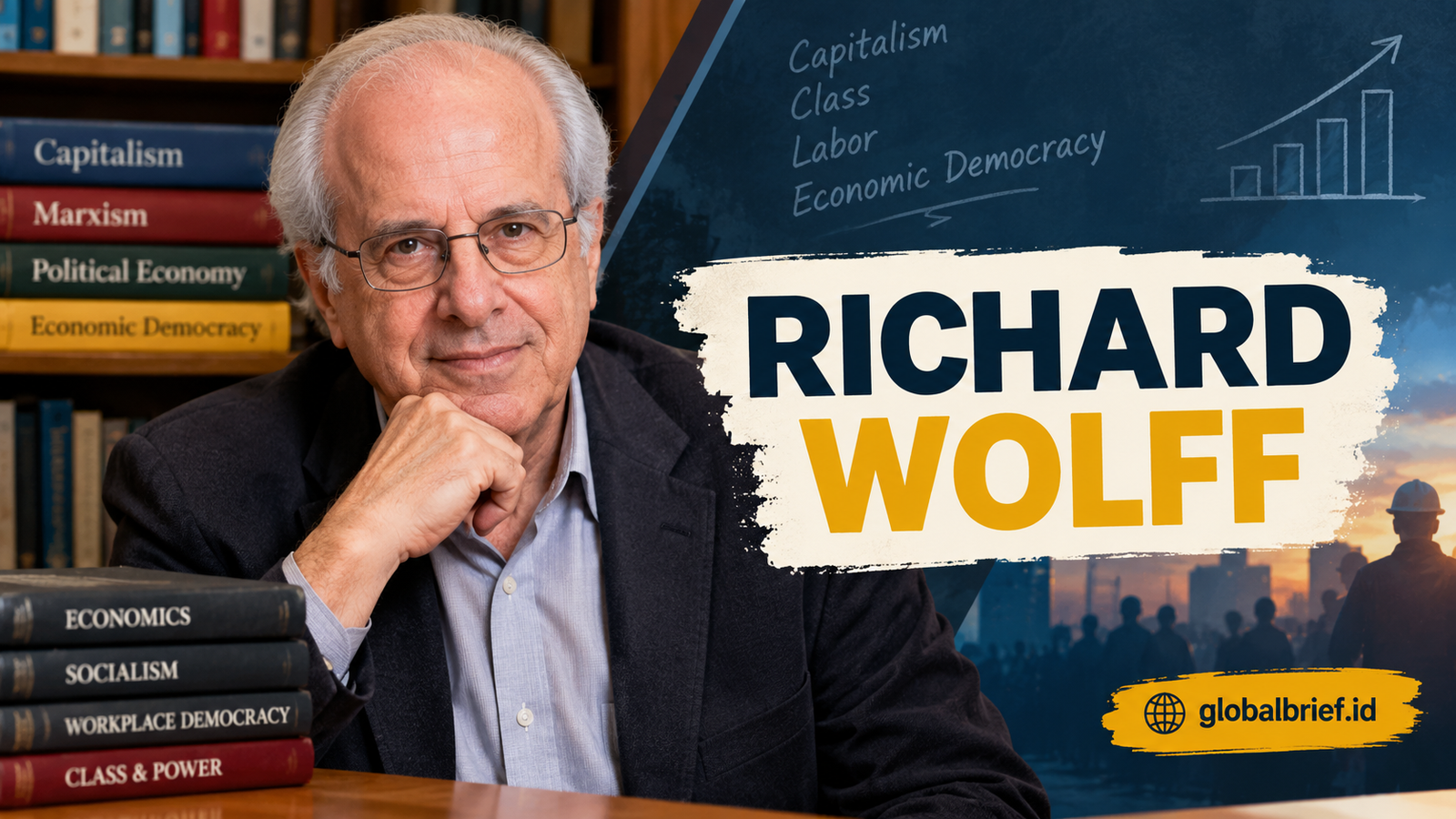
Richard Wolff is an American economist widely known for his work on Marxian economics, political economy, capitalism, class, and workplace democracy. Over several decades, he has examined how economic systems distribute wealth and power and why decisions made inside businesses matter to the wider economy. He has also become known for explaining complex economic ideas in accessible language through books, lectures, interviews, and his long-running Economic Update program. Wolff is professor of economics emeritus at the University of Massachusetts Amherst and has also served as a visiting professor at The New School in New York.
Who Is Richard Wolff?
Richard D. Wolff developed his academic career around political economy and Marxian economic analysis. His education included Harvard University, Stanford University, and Yale University, where he earned his doctorate in economics. He later taught economics at several institutions, including Yale, the City University of New York, and the University of Massachusetts Amherst. According to his academic biography, he taught at UMass Amherst from 1973 to 2008.
His work differs from conventional economic analysis because he places considerable attention on class relationships and the organization of production. Instead of looking only at prices, markets, or economic growth, he asks who owns productive assets, who makes important decisions, and how the results of production are distributed.
This perspective has made Wolff an influential voice among people interested in Marxist economics and alternative economic models. At the same time, understanding his work requires recognizing that many of his conclusions are interpretations within a particular economic tradition rather than universally accepted positions among economists.
His Approach to Economics
A central feature of Wolff’s approach is the importance he gives to class. In his interpretation of capitalism, an economy cannot be fully understood simply by examining consumers and businesses as separate market participants. The relationships between employers and employees inside the workplace are also economically significant.
Wolff frequently examines the difference between owning a business and working in one. In a conventional capitalist enterprise, owners or shareholders generally have authority over major decisions, while employees receive wages in exchange for their labor. Wolff argues that this structure creates an important division of economic power.
His Marxian perspective focuses attention on how production is organized and who controls the surplus generated by economic activity. This approach draws from the tradition established by Karl Marx while also attempting to apply those ideas to modern economies.
The University of Massachusetts Amherst describes Marxian economics as a perspective within political economy that develops from Marx’s economic writings and examines changing capitalist systems. Wolff’s academic work belongs to this broader intellectual tradition.
Why Class Matters in His Analysis
For Wolff, class is not simply a description of income differences. He uses the concept to examine people’s roles in the production process.
Workers typically sell their ability to work for wages, while owners control businesses and productive resources. This distinction can affect who makes decisions about investment, production, working conditions, and the use of profits.
Wolff argues that economic inequality is therefore connected to institutional structures, not only to differences in individual skills or effort. His analysis asks readers to consider whether an economy can be genuinely democratic when most people spend their working lives in organizations where they have limited authority over major decisions.
This is one reason workplace organization occupies such an important position in his writing. Rather than treating the workplace as a private matter unrelated to economics, he considers it a central economic institution.
Workplace Democracy
One of the most recognizable ideas associated with Wolff is workplace democracy. His proposal involves greater worker participation in the ownership and management of enterprises.
Through his organization Democracy at Work, Wolff has promoted the concept of worker self-directed enterprises. These enterprises are designed around worker ownership and democratic decision-making rather than the traditional separation between owners and employees.
The idea does not simply mean that employees should receive better treatment from managers. It goes further by asking who has authority over fundamental business decisions.
Questions such as what a company produces, how investment is allocated, how profits are distributed, and how working conditions are determined become matters for democratic participation.
Wolff presents this model as an alternative economic structure. Whether such enterprises can operate effectively at different scales is a subject that involves economic, organizational, and practical questions, but the concept is central to his critique of capitalism.
Richard Wolff and Marxian Economics
Wolff’s connection to Marxian economics is particularly important when studying his work. Marxian economics examines capitalism through concepts such as class, labor, production, accumulation, and the distribution of economic power.
Wolff does not present Marx merely as a historical figure. His books and lectures frequently attempt to explain why Marx’s analysis remains relevant to contemporary economic questions.
His book Understanding Marxism focuses on class struggle and Marx’s criticism of capitalism. The work was originally published in 2018 and has subsequently appeared in expanded editions.
His broader academic record also includes extensive scholarly work on Marxian political economy. His curriculum vitae lists books and research examining class, capitalism, Marxism, and economic theory, including work co-authored with economist Stephen A. Resnick.
Major Books and Ideas
Wolff has written extensively for both academic and general audiences. His books include Democracy at Work, Understanding Capitalism, Understanding Marxism, and Understanding Socialism, among others.
Democracy at Work develops his argument that economic democracy can be pursued through worker-owned and worker-directed enterprises. The book connects workplace authority with broader questions about democracy and economic power.
Understanding Capitalism takes a more introductory approach to defining capitalism and examining its major characteristics. The book discusses capitalism’s structure, its recurring problems, and possible alternatives. A newer edition was published in 2024.
Understanding Socialism examines the meaning and historical development of socialism while emphasizing workplace democracy as a possible foundation for a modern socialist economy.
These books show a consistent theme in Wolff’s work: economic institutions should be examined not only for what they produce but also for how they distribute decision-making power.
Economic Update and Public Education
Another major part of Wolff’s public influence comes from his educational work. His weekly program Economic Update discusses economic developments, employment, debt, inequality, capitalism, and related issues.
The program reflects his effort to make economic concepts understandable to people without formal training in economics. Rather than relying exclusively on academic terminology, Wolff often connects economic theories to everyday experiences such as wages, housing costs, employment, debt, and business decisions.
His public education work has helped bring Marxian economic ideas to audiences beyond universities. Democracy at Work identifies him as the host of Economic Update and lists his books and academic background.
How His Ideas Are Debated
Wolff’s ideas are influential within Marxian and socialist economic discussions, but they are not universally accepted by economists. His analysis represents a particular school of political economy and places substantially more emphasis on class and workplace ownership than many mainstream economic models.
This distinction is important when evaluating his arguments. His criticisms of capitalism should be understood as part of an established intellectual tradition rather than treated as neutral descriptions on which all economists agree.
At the same time, studying Wolff can be useful even for readers who disagree with his conclusions. His work encourages readers to examine questions that conventional economic discussions can sometimes leave in the background, particularly questions about ownership, authority, bargaining power, and the distribution of economic surplus.
Why Richard Wolff Remains Relevant
Interest in Wolff’s work continues because questions about inequality, wages, corporate ownership, worker power, and economic democracy remain significant subjects of public discussion.
His contribution is especially relevant for readers who want to understand economics from perspectives outside the mainstream. He provides a framework for examining capitalism through the organization of production and the relationship between owners and workers.
His work also demonstrates why economic debates are rarely limited to statistics. Different economic traditions can interpret the same economic system through different assumptions about ownership, incentives, power, and social priorities.
Frequently Asked Questions
What is Richard Wolff known for?
Richard Wolff is best known for his work in Marxian economics, political economy, criticism of capitalism, and advocacy of workplace democracy. He is also known for public economic education through his books, lectures, and Economic Update program.
Is Richard Wolff a Marxist economist?
Yes. Wolff identifies with Marxian economics and is widely described by his organization and other sources as a Marxist or Marxian economist. His work focuses heavily on Marx’s analysis of class, capitalism, and production.
What does Wolff mean by workplace democracy?
Wolff’s concept of workplace democracy involves giving workers greater ownership and decision-making authority within enterprises. His proposed worker self-directed enterprises are intended to make economic decision-making more democratic.
What books has Richard Wolff written?
His major books include Democracy at Work, Understanding Marxism, Understanding Socialism, and Understanding Capitalism. His broader academic bibliography also contains numerous scholarly books and articles on Marxian political economy.
Conclusion
Richard Wolff has built a distinctive place in modern economic discussion by focusing on capitalism, class, ownership, and workplace power. His Marxian approach asks readers to look beyond markets and prices and examine how economic institutions are organized and who controls them. Through academic research, books, and public education, he has made these subjects accessible to a broad audience.
Whether readers agree with his conclusions or approach his work critically, studying Wolff provides an opportunity to understand an important tradition within political economy. His emphasis on workplace democracy also raises broader questions about the relationship between economic power and democratic participation, making his work a continuing subject of discussion for students, workers, researchers, and readers interested in the structure of modern economies.